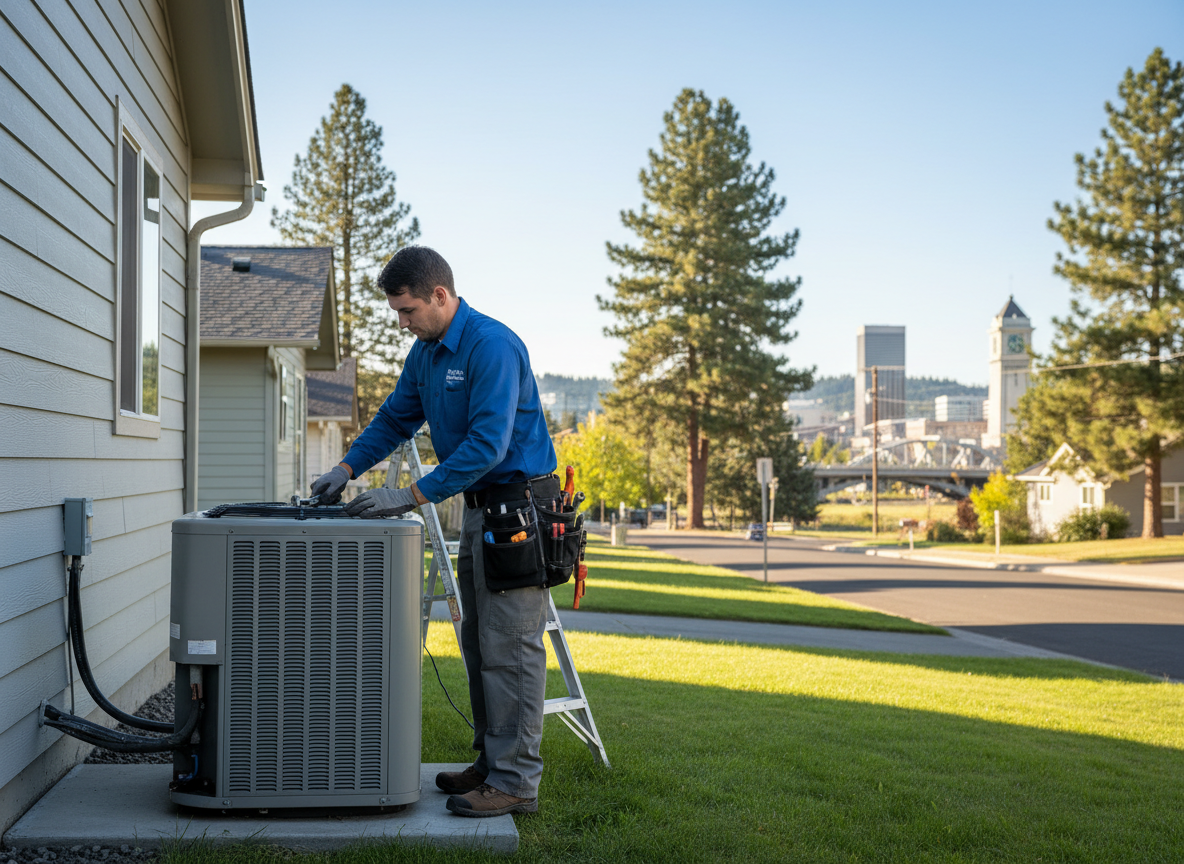
Air conditioner repair starts with a full system check to identify why cooling has stopped or become inconsistent. Technicians test for issues like weak airflow, unusual noises, or warm air output that point to specific component problems.
Common failure symptoms include the unit running constantly without reaching set temperature, ice buildup on coils, or clicking sounds from the start relay. These signs often trace back to electrical parts, motors, or sealed system leaks.
Components that may require testing include the compressor, run capacitor, fan motors, thermostat, and control board. Each is checked with meters and visual inspection before any repair decision.
Repair versus replace depends on the age of the unit, cost of parts, and overall condition. Older systems in Spokane homes built before 1990 often face repeated failures once one major part goes out.
Before service, clear access to the indoor and outdoor units, note any recent changes in performance, and have the model number ready so the technician can reference specifications quickly.
Technician insight
In Spokane, the thing that catches most people out with Air Conditioner Repair is how our long cold winters shorten the life of capacitors and fan motors in homes built in the 1970s and 1980s. Those older systems often sit unused for months then get slammed in July, so a single weak part fails fast. Homeowners frequently replace the capacitor only to have the compressor go next because the underlying wear from age and temperature swings was never checked.
South Hill Home With No Cooling
A homeowner on Spokane's South Hill reported the air conditioner running nonstop yet the house stayed warm. Testing showed a failing run capacitor and low refrigerant from a small leak at the outdoor coil. The capacitor was replaced and the leak repaired, after which the system reached temperature and ran normal cycles.
Air Conditioner Repair Services We Offer
✓Compressor Testing
Checks compressor function and electrical draw to determine if it can be repaired or needs replacement, preventing full system failure during peak summer use.
✓Fan Motor Replacement
Replaces worn blower or condenser fan motors that cause poor airflow or grinding noises, restoring proper cooling circulation through the home.
✓Capacitor Testing and Replacement
Tests and swaps failing start or run capacitors that prevent the unit from turning on reliably, a frequent issue after Spokane's cold winters.
✓Refrigerant Leak Detection
Locates and addresses leaks in the sealed system that lead to low cooling performance and higher energy use.
✓Thermostat Calibration
Adjusts or replaces thermostats that give inaccurate readings, improving temperature control without replacing the entire air conditioner.
✓Control Board Diagnostics
Diagnoses faulty circuit boards that cause erratic operation or error codes, allowing targeted repair instead of guessing at multiple parts.
How it works
- 1
Initial Assessment
The technician arrives and reviews the symptoms you noted while visually inspecting both indoor and outdoor sections of the system.
- 2
Component Testing
Electrical readings, pressure checks, and motor tests identify which parts are underperforming or failed.
- 3
Findings Review
Results are explained on site with clear options for repair or replacement based on the unit's condition.
- 4
Service Completion
Approved work is performed and the system is run through a final test cycle before leaving.
Pricing
Cost varies with the parts required, accessibility of the unit, and whether repair or replacement is chosen.