
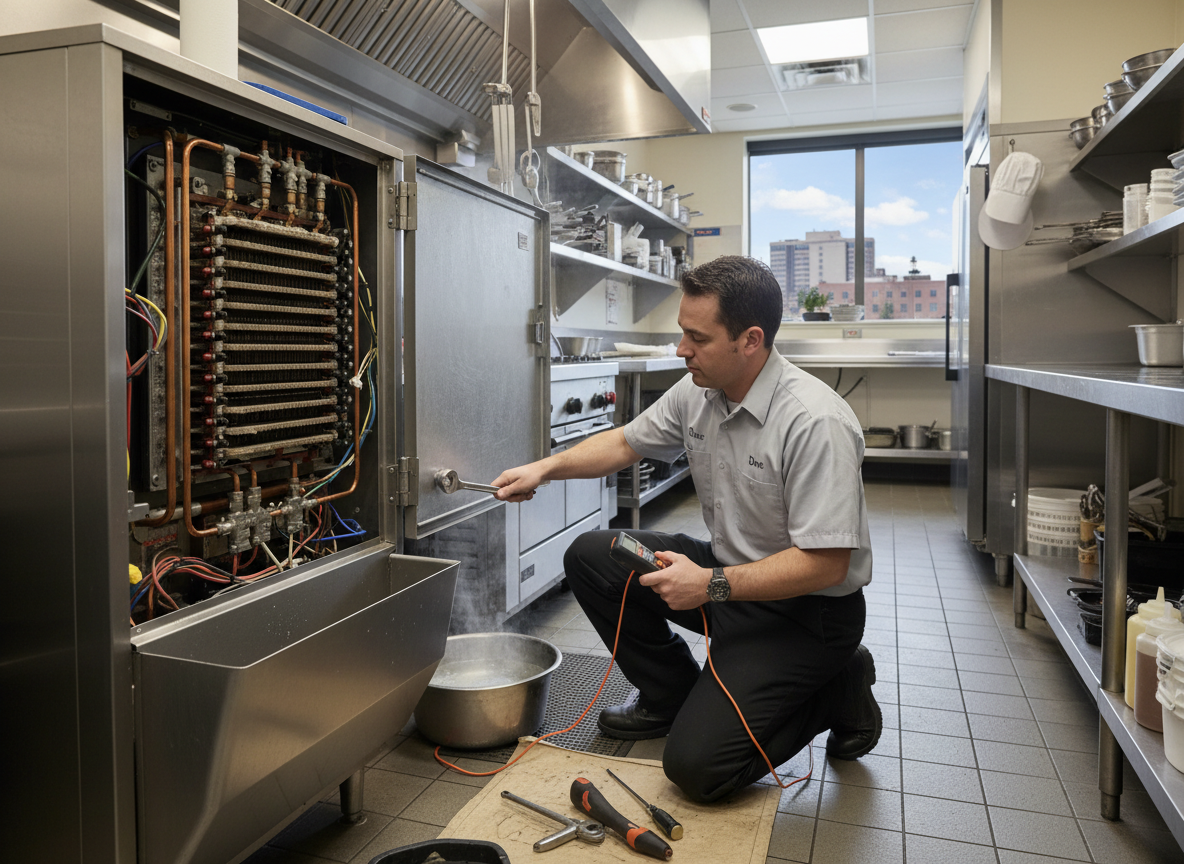
Commercial ice machines in Spokane often develop problems from mineral deposits in the water supply, inconsistent temperatures, or worn internal parts. Diagnosis starts with checking ice production rates, listening for unusual noises, and inspecting for leaks or error codes on the control panel. Common failure symptoms include slow or no ice output, hollow cubes, strange odors, or machines that run continuously without harvesting ice.
Technicians test components such as the water inlet valve, compressor, evaporator plates, bin sensors, and condenser coils. They also evaluate the thermostat and control board for accuracy. Repair versus replace decisions depend on the machine's age, extent of corrosion, and cost of major parts like compressors versus the price of a new unit.
Before service, customers should clear access to the machine, note any error codes displayed, and have the model number ready. They should also confirm whether the unit is under any existing manufacturer coverage and prepare a list of recent performance changes.
Repair vs Replace Considerations
Age of the machine, frequency of prior repairs, and availability of compatible parts in the Spokane area all factor into the decision. When internal corrosion has spread beyond the evaporator or the compressor shows low compression, replacement often becomes the practical choice.
What to Prepare Before Service
Have the machine model and serial numbers visible, clear floor space around the unit, and note the last time the machine was cleaned or serviced. Providing recent photos of ice output or error lights helps the technician arrive with likely parts.
Technician insight
In Spokane, the thing that catches most people out with Commercial Ice Machine Repair is how quickly hard water from the local supply builds scale inside the inlet valve and evaporator, often causing what looks like a sensor failure when the real issue is restricted flow.
Slow Production on a Restaurant Ice Machine
A downtown Spokane restaurant reported the machine taking twice as long to fill the bin. Inspection showed heavy mineral scale on the evaporator plates and a partially clogged water inlet valve. The valve was replaced and plates were descaled on site. Ice production returned to normal levels the same day.
Commercial Ice Machine Repair Services We Offer
✓Water Inlet Valve Service
Restores proper water flow to prevent slow production and oversized or misshapen ice cubes caused by restricted valves.
✓Compressor Diagnostics
Identifies electrical or mechanical failure in the compressor so the machine can resume consistent cooling cycles.
✓Evaporator Plate Cleaning
Removes scale and mineral buildup that reduces ice harvest efficiency and leads to cloudy or irregular cubes.
✓Bin Sensor Calibration
Adjusts optical or mechanical sensors so the machine stops production when the bin is full and avoids overflow or dry cycling.
✓Condenser Coil Maintenance
Clears dust and grease from coils to improve heat exchange and reduce compressor strain during Spokane summers.
✓Control Board Testing
Verifies circuit board functions and replaces faulty relays or sensors that cause erratic operation or failure to start.
How it works
- 1
On-Site Assessment
The technician inspects the machine, records error codes, and measures production output against manufacturer specifications.
- 2
Component Testing
Each suspect part is checked with multimeters, pressure gauges, and visual inspection for wear or blockage.
- 3
Targeted Repair
Failed components are repaired or replaced using compatible parts, followed by system flushing where mineral scale is present.
- 4
Performance Verification
The machine runs through full cycles while ice quality, harvest time, and energy draw are confirmed before departure.
Pricing
Pricing depends on the specific components that need attention, machine age, and whether major parts such as compressors or control boards are required.