
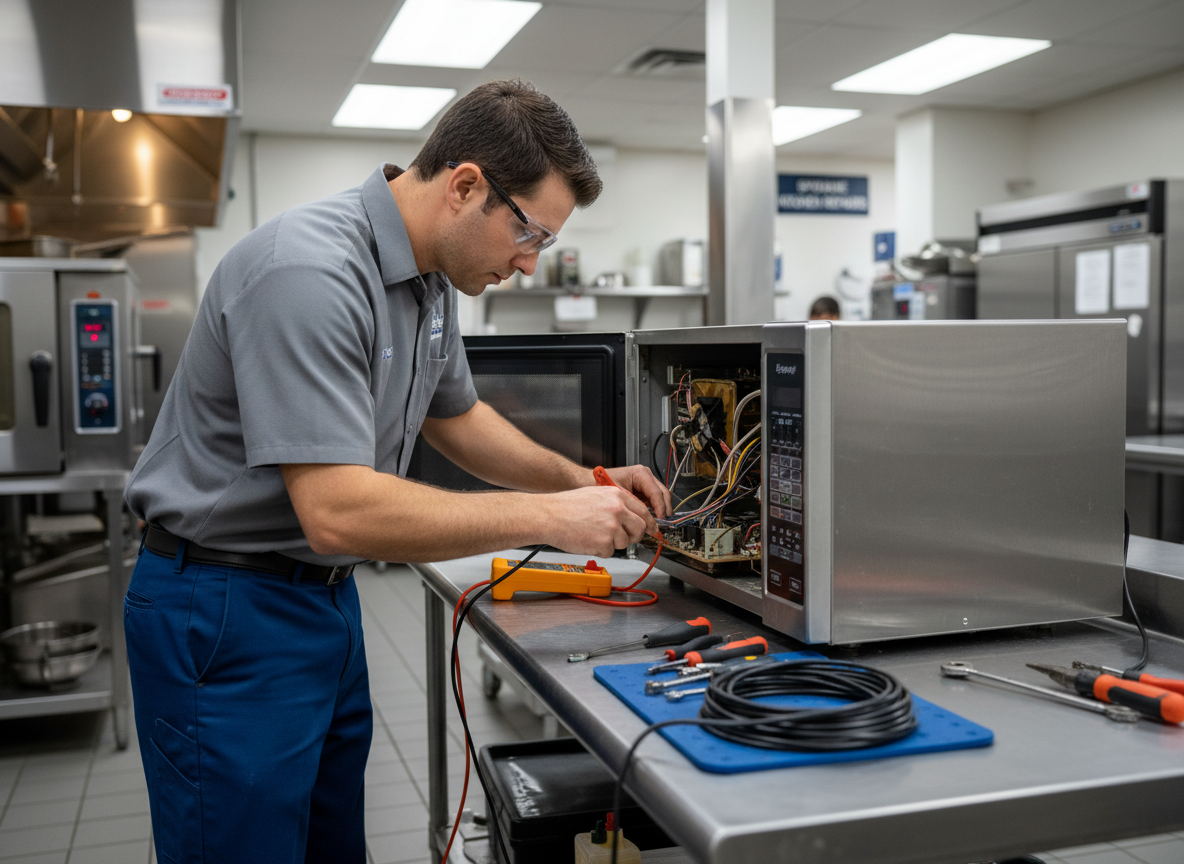
Commercial microwaves in Spokane see heavy daily use in restaurants and cafeterias, where even brief downtime affects service. Diagnosis starts with confirming power delivery and checking for error patterns before any parts are opened. Technicians test the magnetron, high-voltage diode, capacitor, and door interlock switches because these parts account for most failures in high-volume settings. Customers should note the model number, describe the exact symptom, and clear space around the unit so the technician can work safely.
Common Failure Symptoms
Units often stop heating while lights and fans still run, point to a failed magnetron or diode. Erratic beeping, unresponsive touchpads, or the turntable not spinning usually trace back to control board issues or motor problems. Sparks or burning smells inside the cavity frequently come from a damaged waveguide cover or food debris buildup.
Components That May Require Testing
Testing sequence covers the high-voltage capacitor for charge retention, the diode for continuity, and the magnetron for proper output. Door switches are checked for correct alignment because misalignment prevents the unit from starting. The stirrer or turntable motor is run under load to confirm smooth operation.
Repair-Versus-Replace Considerations
When the magnetron and multiple switches need replacement at once, the cost can approach that of a new commercial unit. Older models with discontinued parts often make replacement the practical choice. Newer units with available boards and diodes are usually worth repairing if the cavity and ventilation remain in good shape.
Technician insight
In Spokane the thing that catches most people out with commercial microwave repair is the age of the electrical service in older downtown buildings; many still run on 208-volt three-phase that can mask a failing capacitor until the unit trips breakers during lunch rush.
Restaurant Microwave Stops Heating Mid-Shift
The unit lit up but produced no heat after a busy breakfast period. Testing showed an open high-voltage diode and a weakened magnetron. The diode was swapped first; when heating remained weak the magnetron was replaced. The microwave returned to full output and the kitchen avoided replacing the entire appliance.
Commercial Microwave Repair Services We Offer
✓Magnetron Testing
Confirms whether the magnetron produces consistent output so heating performance can be restored without replacing the entire unit.
✓High Voltage Diode Replacement
Restores the one-way current path needed for proper voltage to the magnetron and prevents repeated fuse failures.
✓Door Switch Adjustment
Aligns and tests interlock switches so the microwave starts reliably and meets safety cut-off requirements.
✓Control Board Diagnostics
Reads error codes and checks board outputs to isolate keypad or timer problems without guessing at multiple parts.
✓Waveguide Cover Replacement
Removes burned or arcing covers that allow sparks and replaces them to protect the waveguide from further damage.
✓Turntable Motor Service
Tests and replaces the motor that rotates the tray so food heats evenly and the unit avoids overload shutdowns.
How it works
- 1
Symptom Review
The technician asks for the exact sequence of events and checks the model plate for commercial rating.
- 2
Component Testing
Power is isolated and each major part is checked with a meter before any disassembly proceeds.
- 3
Parts Decision
Findings are explained so the customer can weigh repair cost against unit age and usage.
- 4
Completion and Check
Repaired functions are run through a full cycle and the workspace is left clean.
Pricing
Cost depends on which components are faulty and whether parts are still stocked for that model.