
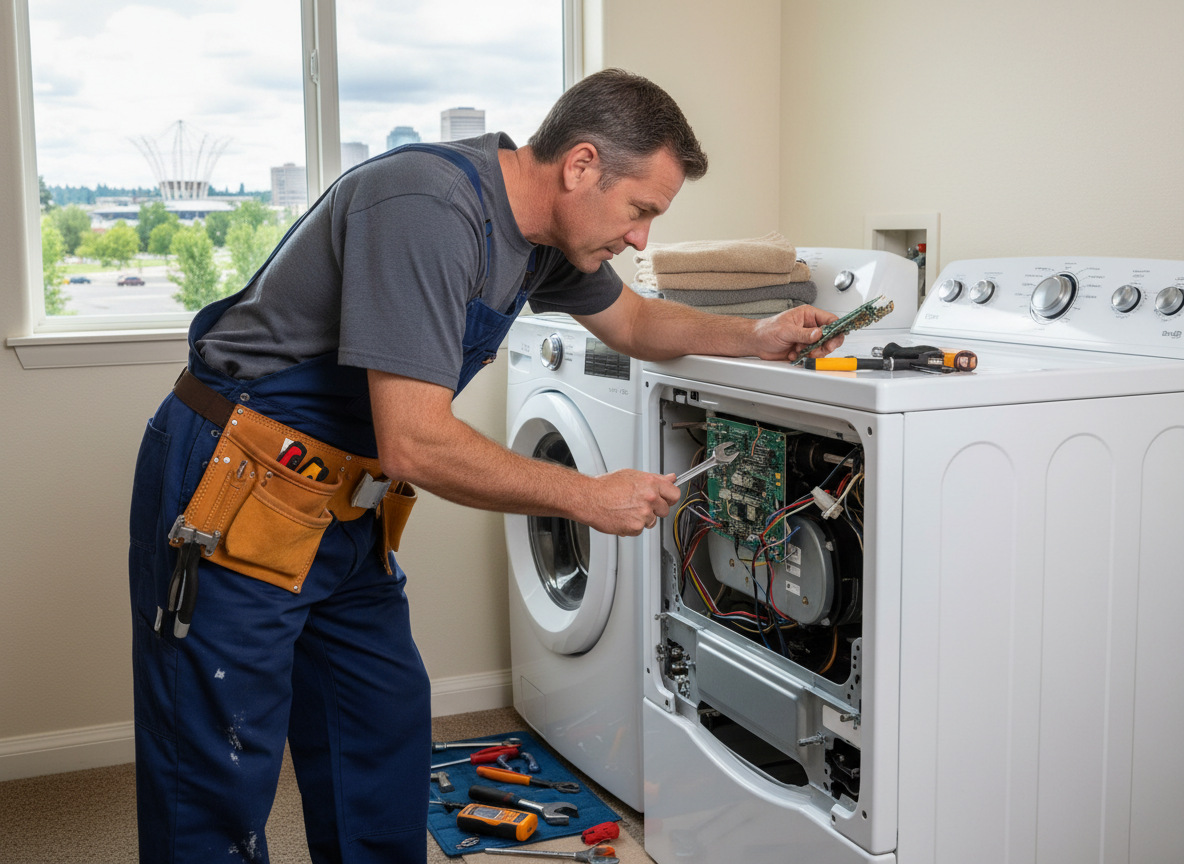
Dryer repair begins with a structured diagnosis that checks power supply, airflow, heat generation, and mechanical rotation. Technicians test for continuity on heating elements, thermostats, and thermal fuses while measuring voltage at the outlet. Common failure symptoms include clothes remaining damp after a full cycle, unusual grinding or squealing during operation, failure to start, or excessive heat on the exterior cabinet. Components frequently requiring testing are the heating element, high-limit thermostat, thermal fuse, drum rollers, idler pulley, drive belt, blower motor, and door switch.
Repair versus replace decisions hinge on the age of the unit, cost of the failed part, and overall condition of the drum and cabinet. In many Spokane homes with dryers over ten years old, replacement becomes the practical choice once multiple safety components have failed. Customers should prepare by clearing a path to the dryer, noting any error codes on digital models, and confirming whether the unit is gas or electric before the appointment.
Common Failure Symptoms
Homeowners in Spokane most often report extended drying times during winter months when indoor humidity drops and lint dries into hard clumps inside the vent pipe. Grinding noises usually trace to worn drum rollers or a failing idler pulley, while no-heat complaints frequently involve an open thermal fuse or faulty heating element after repeated high-heat cycles.
Repair Versus Replace Considerations
When the heating element and thermostat both require replacement on an older unit, the combined parts and labor often approach the cost of a new basic model. Local parts availability for common Whirlpool, Maytag, and GE models keeps many repairs economical, but units with rusted drums or seized motors are rarely worth restoring.
Technician insight
In Spokane the thing that catches most people out with dryer repair is how our long dry winters turn lint into concrete-like plugs inside exterior vents on older homes. Homeowners keep replacing heating elements when the real problem is restricted airflow from decades-old vent pipe that was never cleaned after the house was built.
No-Heat Diagnosis On Electric Dryer
The dryer ran but produced no warmth after several loads. Testing showed an open thermal fuse and heavy lint packed in the blower housing. The fuse was replaced and the vent line was cleared from the machine to the roof termination. The dryer now heats on the first cycle and shuts off on time.
Dryer Repair Services We Offer
✓Heating Element Replacement
Restores full heat output by testing resistance and replacing failed coils that no longer generate warmth.
✓Drum Roller and Idler Pulley Repair
Eliminates squealing and thumping by replacing worn rollers and tension pulleys that support the drum during rotation.
✓Thermal Fuse and Thermostat Testing
Verifies safety cutoffs and temperature controls to prevent repeated no-heat shutdowns caused by tripped fuses.
✓Blower Motor and Capacitor Service
Restores proper airflow and tumbling speed by diagnosing motors that run intermittently or fail to start.
✓Vent Cleaning and Airflow Restoration
Removes compacted lint from the internal blower and external vent line to shorten drying cycles and reduce fire risk.
✓Door Switch and Seal Replacement
Corrects units that fail to start or leak heat by replacing faulty door switches and deteriorated gaskets.
How it works
- 1
Initial Symptom Review
Technician asks about cycle performance, noises, and any recent changes in drying time or heat level.
- 2
Component Testing
Multimeter checks are performed on the heating element, thermostats, fuse, motor windings, and switches.
- 3
Airflow And Vent Inspection
Lint buildup is measured inside the machine and at the exterior termination point.
- 4
Repair Execution
Failed parts are replaced and the unit is reassembled with new gaskets where needed.
- 5
Function Verification
A test cycle confirms proper heat, rotation, and automatic shutoff before the technician leaves.
Pricing
Cost depends on which components need replacement, parts availability for the specific brand and model, and whether venting requires additional clearing.