
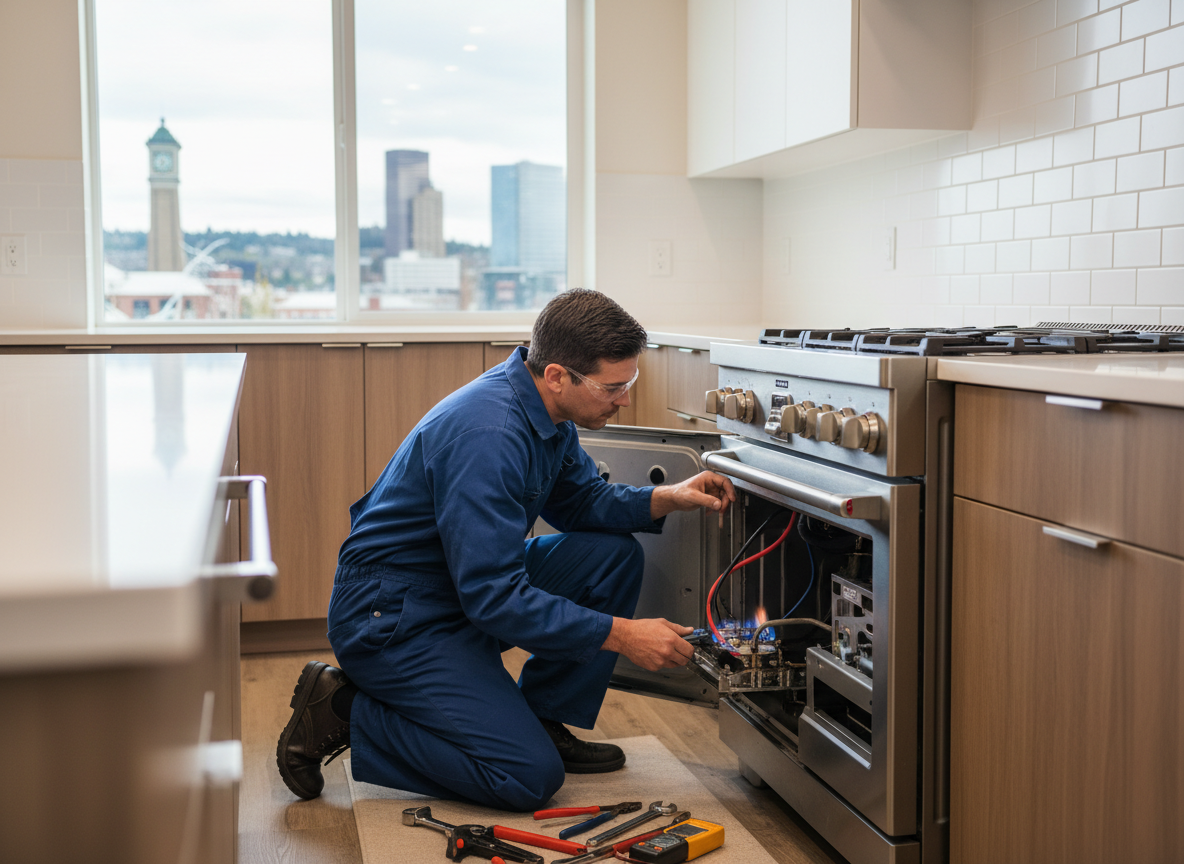
Gas range issues in Spokane homes often show up as uneven heating, burners that won't light, or clicking that never stops. Diagnosis starts with checking gas supply and spark or glow igniters, then moves to valves and thermostats. Technicians test each component in sequence rather than guessing, which keeps the job focused on the actual fault.
Common failure symptoms include weak or yellow flames, ovens that run too hot or too cold, and gas smells near the range. These point to worn igniters, sticking valves, or degraded door seals that let heat escape. Homeowners notice the problems first during heavy use in colder months.
Components that may require testing include the spark igniter, gas control valve, oven thermostat, safety shutoff, and burner orifices. Each is checked for continuity, gas flow, and proper calibration before any parts are ordered.
Repair versus replace decisions hinge on the age of the range, cost of the needed parts, and whether multiple systems are failing at once. A single igniter fix often makes sense on an otherwise solid unit, while widespread valve and control issues may tip the scale toward replacement.
Before service, clear the area around the range, note any error codes or recent changes in performance, and have the model number ready. This lets the tech move straight to testing instead of moving obstacles or searching for identification plates.
Repair vs Replace Considerations
Factors include how many parts show wear, availability of matching components for older models common in Spokane neighborhoods, and overall condition of the cooktop and oven sections. A focused repair on one system usually costs less than a new range when the rest of the unit is still reliable.
What to Prepare Before the Visit
Move nearby items away from the range, confirm the gas shutoff location, and list the exact symptoms and when they occur. Having the manual or model number visible helps confirm specifications during testing.
Technician insight
In Spokane, the thing that catches most people out with Gas Range Repair is older homes with settled foundations that shift gas line connections slightly over decades, so a valve job sometimes turns into an extra step of checking and tightening the supply line before the range can be put back in service.
Burner Clicking Without Lighting
Homeowner reported one front burner would click continuously but never ignite. Testing showed a cracked igniter electrode and minor debris in the orifice. The electrode was replaced and the orifice cleared. The burner now lights on the first try with a steady flame.
Gas Range Repair Services We Offer
✓Igniter Replacement
Restores reliable spark or glow ignition on burners that fail to light consistently.
✓Gas Control Valve Repair
Addresses sticking or leaking valves that cause uneven flame or delayed shutoff.
✓Burner Orifice Cleaning
Clears debris and adjusts gas flow for steady blue flames and efficient heating.
✓Oven Thermostat Calibration
Corrects temperature drift so the oven maintains the set heat without overshooting.
✓Door Gasket Replacement
Restores the seal around the oven door to prevent heat loss and improve baking results.
✓Safety Shutoff Valve Testing
Verifies the valve cuts gas supply if flame is lost, reducing leak risk.
How it works
- 1
Symptom Review
Discuss observed issues and when they occur to narrow the likely components.
- 2
Component Testing
Check igniters, valves, thermostats, and safety devices in order using appropriate meters and gauges.
- 3
Parts Assessment
Determine which parts need replacement and whether repair or full range replacement is the practical path.
- 4
Repair Completion
Install or adjust the faulty component and verify operation across all burners and oven functions.
Pricing
Cost depends on the specific parts required, condition of the existing range, and time needed for testing and access in the home.