
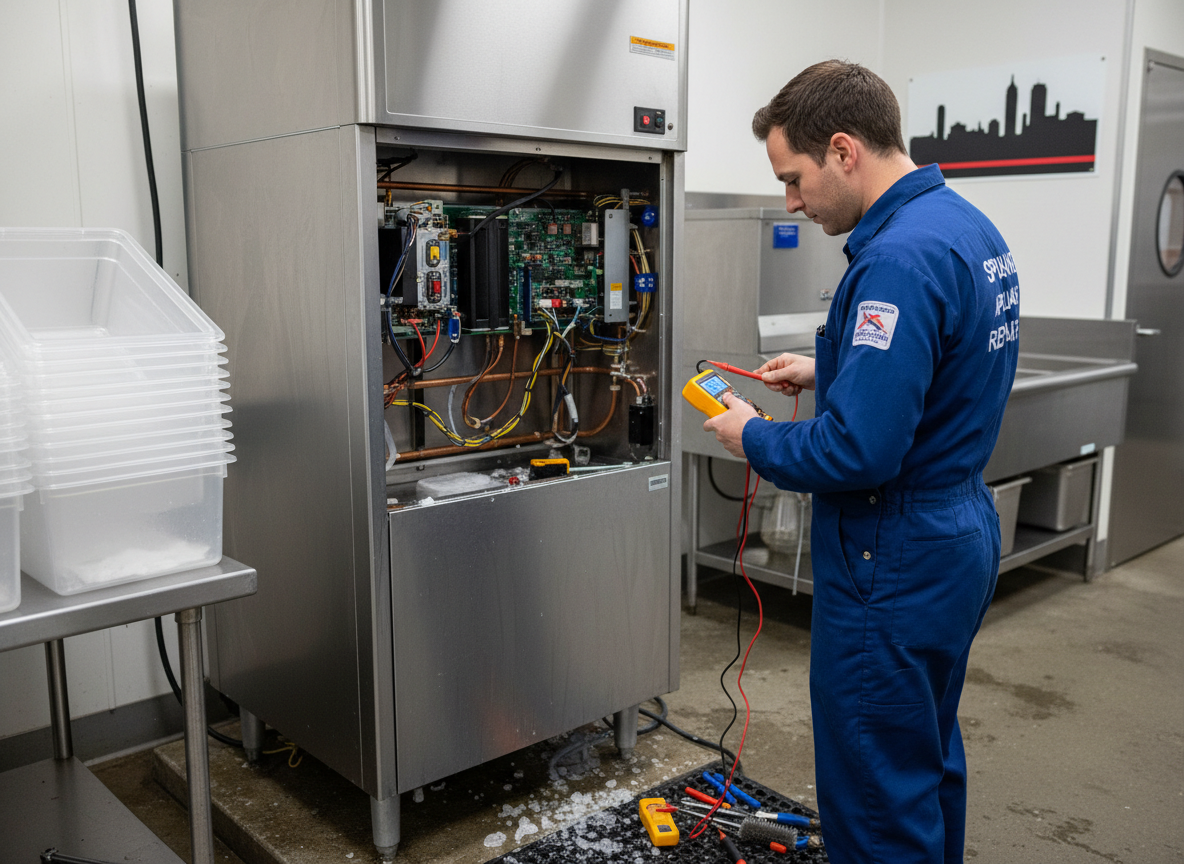
Ice machine repair begins with a full system check to identify why production has slowed or stopped. Common failure symptoms include cubes that are too small, hollow, or missing entirely, along with unusual noises during the harvest cycle or water leaking from the unit base. Technicians test the compressor for proper amperage draw, verify the water inlet valve opens and closes on command, check the thermostat and bin sensor for accurate temperature readings, and inspect the evaporator plate for scale or damage.
Repair-versus-replace decisions hinge on the age of the machine and the extent of the fault. When the compressor or sealed system shows leaks or weak performance, replacement often makes more sense than repair. For issues limited to the inlet valve, sensors, or control board, targeted fixes usually restore function at a lower cost. Customers should clear access around the unit, note any error codes displayed, and have the model number ready before the technician arrives.
Common Symptoms and Component Testing
Homeowners often notice slow ice production first, followed by odd cycling or water backing up in the bin. Testing focuses on the compressor start relay, the water fill solenoid, the harvest heater, and the control board for proper voltage and signal output. Scale from Spokane’s mineral-heavy water frequently coats the evaporator, requiring cleaning before other tests can be completed accurately.
Repair or Replace Guidance
Units under eight years old with isolated electrical or sensor faults are typically repaired. Older machines with compressor or refrigerant issues are evaluated against the cost of a new unit, especially when parts availability for discontinued models becomes limited in the Spokane market.
Technician insight
In Spokane, the thing that catches most people out with Ice Machine Repair is the hard water from the city supply that builds scale fast on the evaporator plate. Homeowners often skip annual cleaning because the machine still makes some ice, then face a sudden stoppage when the scale prevents proper harvest. Addressing the mineral deposit during the first service call usually prevents repeat failures.
Slow Production and Hollow Cubes
The machine was producing small, hollow cubes and running longer cycles than normal. Testing showed heavy scale on the evaporator and a weak water inlet valve that was not filling to the correct level. The valve was replaced and the plate was descaled, after which the unit resumed normal production without further issues.
Ice Machine Repair Services We Offer
✓Compressor Testing
Measures amperage and resistance to confirm whether the compressor can maintain the pressures needed for consistent ice production.
✓Water Inlet Valve Replacement
Replaces the solenoid valve that controls water flow into the machine, restoring proper fill levels and preventing under- or over-filling.
✓Evaporator Plate Cleaning
Removes mineral scale from the freezing surface so ice releases cleanly and production rates return to normal.
✓Bin Sensor Replacement
Installs a new thermostat or optical sensor that accurately detects ice levels and prevents the unit from running when the bin is full.
✓Control Board Diagnostics
Reads error codes and tests voltage outputs to isolate failures in the electronic timing and harvest functions.
✓Harvest Heater Repair
Repairs or replaces the heater element that warms the evaporator during the harvest cycle so cubes release without damage.
How it works
- 1
Initial Assessment
The technician reviews symptoms, checks for error codes, and confirms power and water supply to the unit.
- 2
Component Testing
Each major part is tested in sequence, starting with the water valve and sensors, then moving to the compressor and control board.
- 3
Diagnosis and Options
Findings are explained along with repair versus replacement choices and any parts that may be needed.
- 4
Service Completion
Approved work is performed, the machine is run through a full cycle, and the customer receives operating instructions.
Pricing
Cost depends on the parts required and whether the machine can be repaired or needs replacement; an estimate is given after testing is complete.