
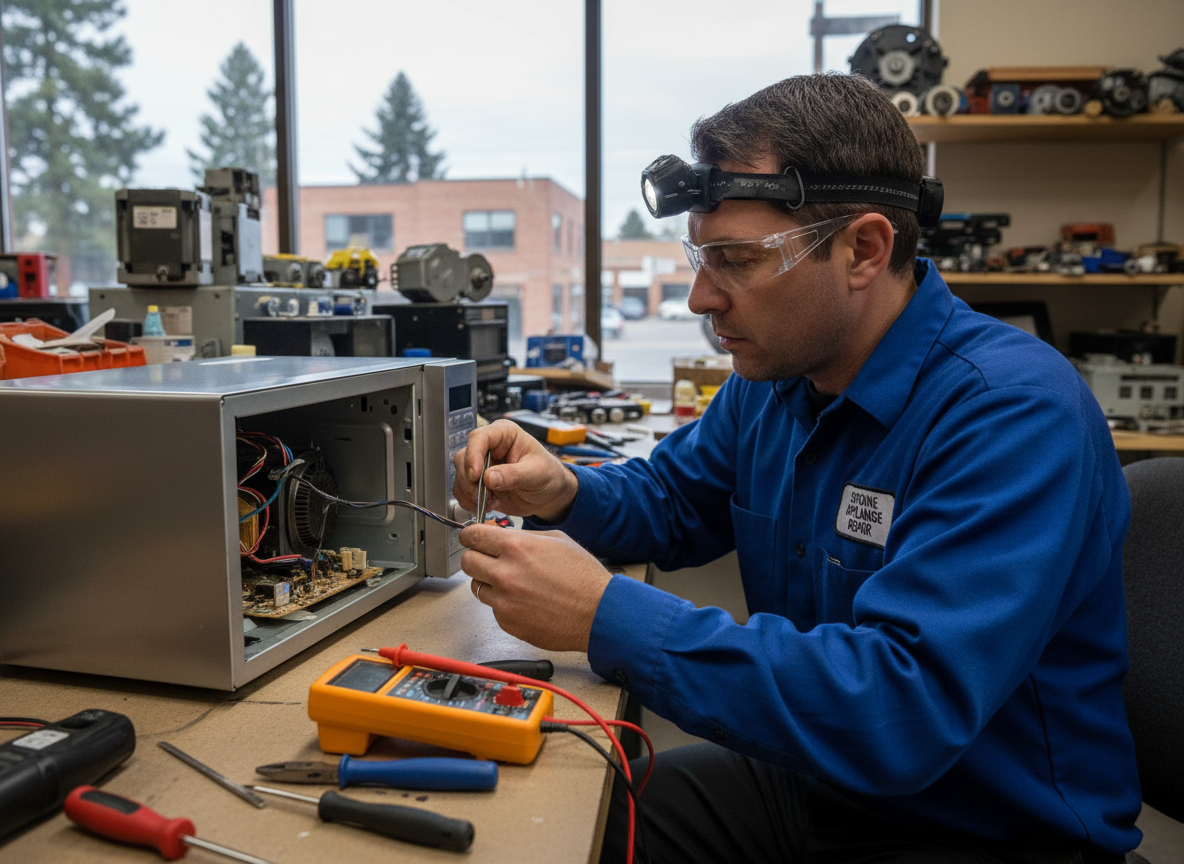
Microwave issues in Spokane homes often start with symptoms like uneven heating or unusual noises that point to specific component failures. Diagnosis begins with checking power supply and safety interlocks before moving to internal parts.
Common components tested include the magnetron, high-voltage capacitor, diode, and turntable motor. Technicians use multimeters and visual inspection to identify faults without unnecessary disassembly.
Repair versus replace decisions hinge on the age of the unit and cost of parts, especially when waveguide covers or door seals show wear from regular use in local kitchens.
Customers should clear counter space around the microwave, note any error codes, and have the model number ready to speed up the service visit.
Common Failure Symptoms
No heat output, sparking inside the cavity, or a humming sound without operation often trace back to the magnetron or capacitor. Door latch failures prevent the unit from starting cycles safely.
Repair vs Replace Considerations
Units under five years old with isolated part failures are typically worth repairing, while older models with multiple worn components may warrant replacement to avoid repeated service calls.
Technician insight
In Spokane, the thing that catches most people out with Microwave Repair is dust and pet hair buildup in older homes near the South Hill that clogs vents and causes overheating. Homeowners often overlook how our dry summers let fine particles accumulate inside the unit until a failure happens. Checking the exhaust path during any service prevents repeat calls.
No Heat on a Five-Year-Old Unit
The microwave ran but produced no heat after several months of normal family use. Testing showed the magnetron had failed while the capacitor and diode remained functional. The magnetron was replaced and the unit restored to full operation.
Microwave Repair Services We Offer
✓Magnetron Replacement
Addresses lack of heating by testing and swapping the magnetron tube when power reaches the component but no energy is produced.
✓Door Latch and Switch Repair
Fixes units that fail to start or shut off unexpectedly by inspecting and replacing worn door switches and latches.
✓Turntable Motor Service
Restores even rotation for consistent cooking results when the glass tray stops turning during operation.
✓High Voltage Capacitor Testing
Identifies and replaces faulty capacitors that cause buzzing noises or intermittent heating problems.
✓Waveguide Cover Replacement
Prevents arcing and food contamination by installing new covers damaged from steam and grease buildup.
✓Control Board Diagnostics
Troubleshoots unresponsive touchpads and error displays through circuit testing and targeted board repairs.
How it works
- 1
Symptom Review
Discuss reported issues and observe the microwave in operation to narrow down likely causes.
- 2
Component Testing
Use diagnostic tools to check the magnetron, capacitor, diode, and safety switches for faults.
- 3
Parts Evaluation
Assess repair costs against unit age and compare to replacement value before proceeding.
- 4
Targeted Repair
Replace or adjust the failing part and verify full function with a test cycle.
- 5
Final Safety Check
Confirm all interlocks and ventilation operate correctly before completing the visit.
Pricing
Pricing depends on the parts required and time spent on diagnostics and testing.