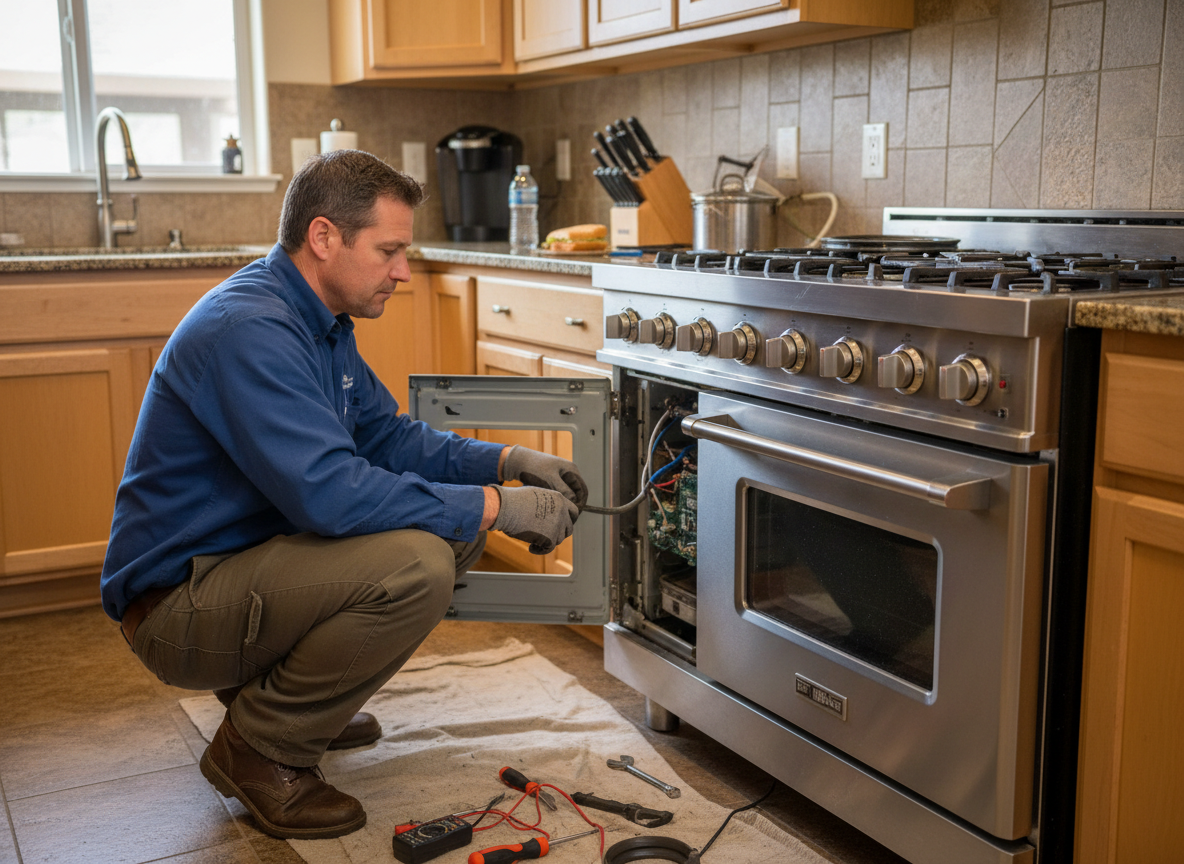
Range and stove top problems often start with uneven heating, burners that won't light, or error codes that appear without warning. A technician begins by testing voltage at the outlet, checking the power cord, then moves to individual components like elements, igniters, and thermostats. Spokane homes built before 1970 frequently have 30-amp circuits that limit simultaneous use of multiple burners and the oven.
Common failure symptoms include a surface element that stays on high regardless of dial position, a clicking igniter that never stops, and an oven that takes over an hour to reach 350 degrees. These point to specific parts that can be tested with a multimeter before any replacement occurs.
Repair versus replace decisions hinge on the age of the unit and the cost of the failed part. When the control board or multiple elements fail on a range older than fifteen years, replacement is often the clearer path. Newer units with electronic controls usually justify repair if the rest of the appliance is in good shape.
Before the technician arrives, clear the area around the range, note any error codes on the display, and have the model number ready. This prevents delays once the service call begins.
Diagnosis Process
Technicians isolate the fault by testing each component in sequence rather than guessing. This approach avoids unnecessary part swaps and keeps the job focused on the actual failure.
What Homeowners Should Prepare
Turn off the breaker to the range if you smell gas or see sparks. Have the manual available if possible so the technician can reference the wiring diagram quickly.
Technician insight
In Spokane, the thing that catches most people out with Range and Stove Top Repair is the number of pre-1960 homes still running on original 30-amp circuits. When two elements and the oven run together the breaker trips, and homeowners assume the range is broken instead of recognizing the wiring limitation.
Oven Not Reaching Temperature
A homeowner in a 1950s Spokane house reported the oven taking two hours to reach temperature and burning food on the bottom rack. Testing showed the lower element had an open circuit while the temperature sensor read correctly. The element was replaced and the oven was recalibrated to restore even baking.
Range and Stove Top Repair Services We Offer
✓Electric Range Element Replacement
Restores even heating on coil or smooth-top ranges by swapping failed surface elements that no longer respond to the control switch.
✓Gas Burner Igniter Repair
Fixes burners that spark continuously or fail to light by replacing worn igniters and checking the spark module.
✓Oven Temperature Sensor Replacement
Corrects inaccurate oven temperatures that cause undercooked or burnt food by installing a new sensor and verifying calibration.
✓Range Control Board Diagnostics
Identifies why certain functions stop working by testing the electronic control board and related wiring harnesses.
✓Door Hinge and Seal Service
Improves heat retention and stops heat loss by replacing worn hinges and deteriorated door gaskets.
✓Broiler Element Repair
Restores top-heat broiling performance by testing and replacing the upper element when it shows visible breaks or fails continuity checks.
How it works
- 1
Initial Safety and Power Check
Verify the outlet voltage and confirm the breaker is sized correctly for the range before any further testing.
- 2
Symptom and Component Testing
Measure resistance on elements, igniters, and sensors to locate the exact failure point.
- 3
Repair or Part Recommendation
Explain findings and give clear options for fixing the faulty part versus replacing the appliance.
- 4
Final Function Test
Run the repaired range through a full cycle to confirm all burners and oven modes operate correctly.
Pricing
Cost depends on whether the issue is a single element, an igniter, or a control board, plus the age and model of the range.